

Book Resume
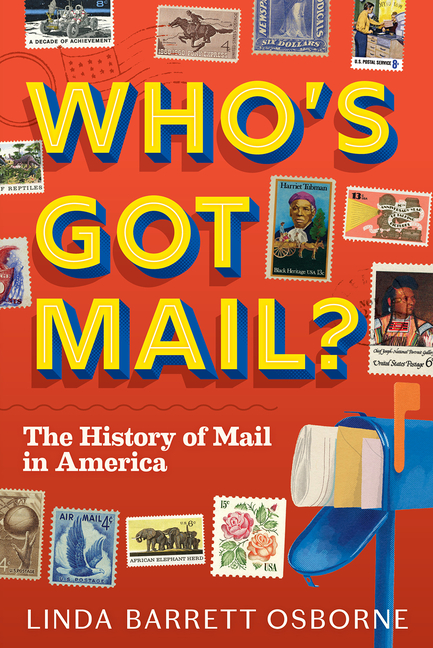
for Who's Got Mail?: The History of Mail in America by Linda Barrett Osborne
Professional book information and credentials for Who's Got Mail?.
3 Professional Reviews (2 Starred)
2 Book Awards
Selected for 1 State/Province List
- School Library Journal:
- Grades 4 - 8
- Booklist:
- Grades 5 - 8
- Kirkus:
- Ages 10 - 14
- TeachingBooks:*
- Grades 5-12
- Genre:
- Nonfiction
- Year Published:
- 2023
2 Subject Headings
The following 2 subject headings were determined by the U.S. Library of Congress and the Book Industry Study Group (BISAC) to reveal themes from the content of this book (Who's Got Mail?).
3 Full Professional Reviews (2 Starred)
The following unabridged reviews are made available under license from their respective rights holders and publishers. Reviews may be used for educational purposes consistent with the fair use doctrine in your jurisdiction, and may not be reproduced or repurposed without permission from the rights holders.
Note: This section may include reviews for related titles (e.g., same author, series, or related edition).
From School Library Journal
Starred review from September 15, 2023
Gr 4-8-This engaging story of the postal delivery service in the United States shares the history of an essential democratic institution considered so foundational to American life that its existence is mandated in the U.S. Constitution. Even early American leaders so wary of centralized government considered a federal postal system necessary to keep citizens informed regarding local and national happenings. Because its mission is to serve all Americans, wherever the postal service has expanded, it literally paved the way for improved transportation and infrastructure. Osborne illustrates with photos the many ways the mail has been delivered, including mules still trekking down the Grand Canyon! American history and the service provided by the postal system are intertwined. Osborne recounts how the postal service has become one of the most diverse workforces, with many overcoming discrimination faced by women and people of color. Chapters and inset text boxes focus on the experiences of women, Black, Asian, Latinx, and Native American workers and shine a light on an employer that has changed over the centuries to reflect the neighborhoods it serves. This may not be the most popular subject, but everyone uses the mail service, and Osborne's meticulous research results in a fascinating history. VERDICT With first class writing, this extremely readable postal history gets delivered with an enthusiastic stamp of approval.-Lisa Crandall
Copyright 2023 School Library Journal, LLC Used with permission.
From Booklist
March 15, 2023
Grades 5-8 What's the most popular and best-selling stamp to date? That and much more are revealed in this informative and fun history of the U.S. Postal Service. It's full of fascinating facts, such as that, in the early 1900s, some parents actually mailed their children via parcel post to visit relatives in order to save the cost of a train ticket! The book recounts how the establishment of post offices around the country led to investment and improvement in the transportation system. The early diversity among adventurous people who worked as postmasters, postal carriers, and clerks is included, and the text discusses the pony express, commemorative stamps, the trials and triumphs of airmail service, zip codes, the lack of post offices on Native reservations, voting by mail, and the postal service's financial problems. Despite issues, surveys show that people, especially those living in rural areas, consider the postal service to be essential. A well-researched and appealingly designed book. With historical and color photos, sidebars, a time line, notes, a selected bibliography, and an index.
COPYRIGHT(2023) Booklist, ALL RIGHTS RESERVED.
From Kirkus
Starred review from March 1, 2023
This first-class history of an essential democratic institution should be a priority for young readers. Besides connecting us, since Colonial days the post office has fostered the expansion and improvement of roads, employment opportunities, provision of medical supplies, transportation, voting access, economic development, and more. Among the surprising facts shared: Mail could be sent without stamps until 1856 (the recipient had to pay to receive the letter), and originally, like other public services, mail delivery was not expected to be profitable. Three separate chapters are devoted to African Americans, women, and Latine, Asian, and Native Americans, testifying to the country's history of systemic bias as well as contributions made by people from these communities. A chapter on the United States Postal Inspection Service is revealing: Mail train robberies, mail theft, and fraud have long tempted grifters. Sections on the future of the USPS, especially in light of 2022 reform legislation and flourishing anti-government sentiment, are notably thorough and evenhanded. Among the abundant, engaging, and informative photos are mule-train and reindeer-team delivery systems; the classical James Farley building, formerly the site of New York City's central post office; and both famous and ordinary people who have made this public service work. The colorful and attractive pages are predominantly light blue with darker blue borders and yellow text boxes that provide interesting tidbits and additional context. A lively, carefully researched, and clearly written narrative. (timeline, notes, bibliography, image credits, index) (Nonfiction. 10-14)
COPYRIGHT(2023) Kirkus Reviews, ALL RIGHTS RESERVED.
2 Book Awards & Distinctions
Who's Got Mail? was recognized by committees of professional librarians and educators for the following book awards and distinctions.
 Junior Library Guild Selections, 2012-2025, Nonfiction Selection, 2023
 SLJ Best Books of the Year, 2010 - 2025, Selection, 2023
1 Selection for State & Provincial Recommended Reading Lists
Who's Got Mail? was selected by educational and library professionals to be included on the following state/provincial reading lists.
United States Lists (1)
Missouri
- Dogwood Nonfiction Reading List, 2024, Grades 6-8
Preview Digital Book
Explore Who's Got Mail? on Marketplace. Access requires OverDrive Marketplace login.
This Book Resume for Who's Got Mail? is compiled from TeachingBooks, a library of professional resources about children's and young adult books. This page may be shared for educational purposes and must include copyright information. Reviews are made available under license from their respective rights holders and publishers.
*Grade levels are determined by certified librarians utilizing editorial reviews and additional materials. Relevant age ranges vary depending on the learner, the setting, and the intended purpose of a book.
Retrieved from TeachingBooks on December 24, 2025. © 2001-2025 TeachingBooks.net, LLC. All rights reserved by rights holders.
