

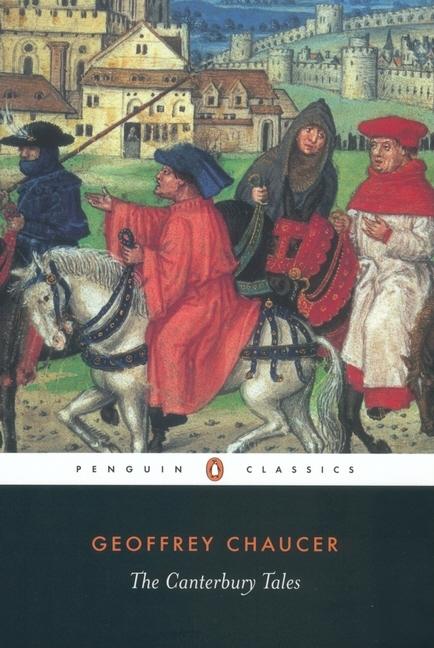
Book Resume
for The Canterbury Tales by Geoffrey Chaucer
Professional book information and credentials for The Canterbury Tales.
- Publisher's Weekly:
- Ages 10 and up
- Publisher's Weekly:
- Ages 10 and up
- TeachingBooks:*
- Grades 9-12
- Word Count:
- 143,797
- ATOS Reading Level:
- 8.1
- Genre:
- Historical Fiction
- Poetry
- Year Published:
- 1478
11 Subject Headings
The following 11 subject headings were determined by the U.S. Library of Congress and the Book Industry Study Group (BISAC) to reveal themes from the content of this book (The Canterbury Tales).
5 Full Professional Reviews
The following unabridged reviews are made available under license from their respective rights holders and publishers. Reviews may be used for educational purposes consistent with the fair use doctrine in your jurisdiction, and may not be reproduced or repurposed without permission from the rights holders.
Note: This section may include reviews for related titles (e.g., same author, series, or related edition).
From Kirkus
November 1, 2009
Burton Raffel has made two key decisions in his rendition of Chaucer's greatest work. While most editions stick to the half-dozen or so best-known stories—the raunchy"Miller's Tale" and the proto-feminist"Wife of Bath's Tale" being the most popular with contemporary readers—Raffel offers modern English versions of even such unfinished fragments as"The Squire's Tale" and such often-skipped sections as"The Parson's Tale." Few today will be burning to hear from the longwinded parson, but in general this unabridged edition is a delight. It lets you appreciate the masterful way Chaucer unifies his stylistically and topically diverse stories with a few overarching themes: the proper relationship between man and woman (the answer's not what you'd expect from a 14th-century civil servant), the role of the clergy (they're only human in his realistic portraits), the all-powerful impact of chance on our destinies. Having the full text also enables readers to enjoy the sly way Chaucer toys with them, allowing his raconteurs to interrupt their narratives with such tantalizing phrases as,"but nothing like that can be included here." The unabridged edition provides more opportunities to savor the counterpoint of Chaucer's earthy humor against passages of piercingly beautiful lyric poetry.
That glorious language—there's the rub in Raffel's second decision. Most modern editions of Chaucer include his Middle English text on the facing page; it's the simplest way to make sure readers know what's going on but still hear Chaucer's distinctive voice. Raffel's modern English captures to a large extent the polyphonic vigor of Chaucer's verse and prose. But he cannot capture Chaucer's voice."When April arrives, and with his sweetened showers / Drenches dried-up roots, gives them power / To stir dead plants and sprout the living flowers / That spring has always spread across these fields," is lovely. Can it equal,"Whan that Aprill with his shoures soote / The droghte of March hath perced to the roote, / And bathed every veyne in swich licour / Of which vertu engendred is the flour"? Of course not, and it would be unfair to expect it. But it would be nice to look across the page from Raffel's lucid, lyrical rendition and be able to see the gnarled yet delicate taproot from which grew Shakespeare, John Donne and the King James Bible.
You can't blame Raffel or Modern Library. An unabridged dual-language version would run more than 1,000 pages, making it prohibitively expensive and inaccessible to non-students who might want to use it somewhere other than at their desks. Keeping the oldest portions of our literary heritage alive for contemporary readers always involves compromise. If we lose some of the deepest levels of Chaucer's poetry here, we are partly compensated with the full sweep of his zestful, unsentimental understanding of human nature and his abiding love for all kinds of good stories.
(COPYRIGHT (2009) KIRKUS REVIEWS/NIELSEN BUSINESS MEDIA, INC. ALL RIGHTS RESERVED.)
From Publisher's Weekly
September 7, 2009
Ackroyd's retelling of Chaucer's classic isn't exactly like the Ethan Hawke'd film version of Hamlet
, but it's not altogether different, either. Noting in his introduction that the source material “is as close to a contemporary novel as Wells Cathedral is to an apartment block,” Ackroyd translates the original verse into clean and enjoyable prose that clears up the roadblocks readers could face in tackling the classic. “The Knight's Tale,” the first of 24 stories, sets the pace by removing distracting tics but keeping those that are characteristic, if occasionally cringe-inducing, like the narrator's insistence on lines like, “Well. Enough of this rambling.” The rest of the stories continue in kind, with shorter stories benefiting most from Ackroyd's treatment, though the longer entries tend to... ramble. The tales are a serious undertaking in any translation, and here, through no fault of Ackroyd's work, what is mostly apparent is the absence of the original text, making finishing this an accomplishment that seems diminished, even if the stories themselves prove more readable.
From Publisher's Weekly
October 1, 1988
Like Charles Lamb's edition of Shakespeare, Hastings's loose prose translation of seven of Chaucer's tales is more faithful to the work's plot than to the poet's language. This is not a prudish retelling (even the bawdy Miller's tale is included here) but the vigor of Chaucer's text is considerably tamed. In the original, the pilgrims possess unique voices, but here the tone is uniformly bookish. The colloquial speech of the storyteller is replaced by formal prose; for example, while Cohen (see review above) directly translates Chaucer's ``domb as a stoon'' as ``silent as stones,'' Hastings writes ``in solemn silence.'' Cartwright's startling paintings skillfully suggest the stylized flatness of a medieval canvas, but often without the accompanying richness of detail. Like Punch and Judy puppets, the faces and voices of these pilgrims are generally representative but lack the life and charm of the original text. Ages 10-up.
From Publisher's Weekly
August 16, 1988
This carefully researched and lively edition of a part of Chaucer's masterwork is richly and beautifully produced. While Cohen admits that ``Chaucer's words are best,'' her prose adaptation of four of his tales captures the zest and vigor of Middle English and makes his stories accessible to the modern child. This is not a pedantic translation or a bowdlerized retelling; Cohen does not substitute weak cliches for Chaucer's rollicking and earthy metaphors, nor does she sacrifice the rhythms of his text. Readers hear the bickering of the pilgrims as they decide on which tale they want to hear next, and the rambling voice of the good Sir John as he laments Chaunticleer's fate. Hyman's meticulous drawings not only evoke the rich panoply of 14th century England, but they are faithful to the text in the smallest detail. Each pilgrim is made particular: we see the Pardoner's limp hanks of hair and the Wife of Bath's gap-toothed smile and dainty ankle. One could not ask for a more enticing introduction to Chaucer's world. Ages 10-up.
From AudioFile Magazine
A knight, a miller, a cook, and a nun are just a few of the more than two dozen lively characters traveling together on an annual pilgrimage from London to Canterbury to visit the shrine of Saint Thomas Becket. They each tell a tale drawn from religion, folklore, classic myth, or even gossip to make the time pass. Geoffrey Chaucer's simple literary device provides an unprecedented and unsurpassed view of his fourteenth-century England. Five of the BBC's most versatile and creative narrators do a marvelous job voicing the personalities of the storytellers. Burton Raffel's very complete and contemporary translation retains the poetic half rhymes of the original Middle English and includes the often severely abridged monk and parson's tales. It never ceases to amaze how immediate and modern Chaucer's world continues to sound. B.P. (c) AudioFile 2009, Portland, Maine
4 Selections for State & Provincial Recommended Reading Lists
The Canterbury Tales was selected by educational and library professionals to be included on the following state/provincial reading lists.
United States Lists (4)
Florida
Louisiana
- Louisiana Believes ELA Guidebooks, Grade 12
New York
- NY Reads, Middle School and High School Titles
- NYS Common Core Aligned Module Titles for Grade 12
Preview Digital Book
Explore The Canterbury Tales on Marketplace. Access requires OverDrive Marketplace login.
This Book Resume for The Canterbury Tales is compiled from TeachingBooks, a library of professional resources about children's and young adult books. This page may be shared for educational purposes and must include copyright information. Reviews are made available under license from their respective rights holders and publishers.
*Grade levels are determined by certified librarians utilizing editorial reviews and additional materials. Relevant age ranges vary depending on the learner, the setting, and the intended purpose of a book.
Retrieved from TeachingBooks on December 24, 2025. © 2001-2025 TeachingBooks.net, LLC. All rights reserved by rights holders.
