

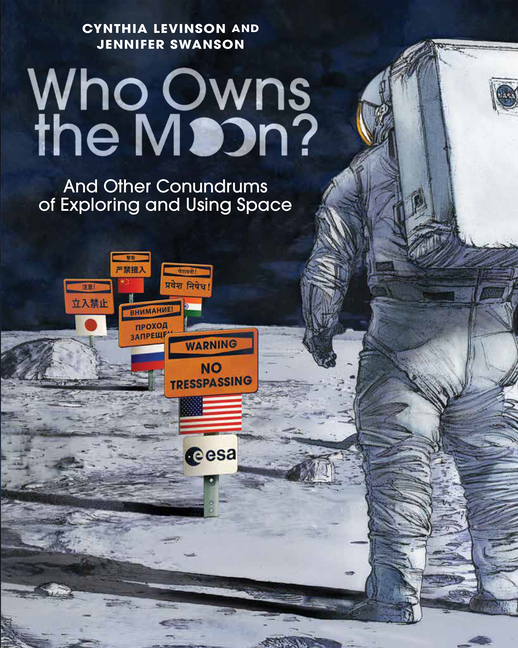
Book Resume
for Who Owns the Moon? by Cynthia Y. Levinson and Jennifer Swanson
Professional book information and credentials for Who Owns the Moon?.
- School Library Journal:
- Grades 7 - 10
- Kirkus:
- Ages 12 and up
- Booklist:
- Grades 7 - 12
- Publisher's Weekly:
- Ages 12 and up
- TeachingBooks:*
- Grades 7-12
- Year Published:
- 2025
1 Subject Heading
The following 1 subject heading were determined by the U.S. Library of Congress and the Book Industry Study Group (BISAC) to reveal themes from the content of this book (Who Owns the Moon?).
6 Full Professional Reviews (2 Starred)
The following unabridged reviews are made available under license from their respective rights holders and publishers. Reviews may be used for educational purposes consistent with the fair use doctrine in your jurisdiction, and may not be reproduced or repurposed without permission from the rights holders.
Note: This section may include reviews for related titles (e.g., same author, series, or related edition).
From Horn Book
May 1, 2025
Approximately fifty years after Apollo 17, NASA's last mission to the moon in 1972, Americans are planning to return. This time the goals are different: landing a diverse crew of astronauts; establishing a base from which to launch deep-space exploration; and studying the moon's resources. But how will these goals be managed? Will the proposed base belong to a single nation or be constructed cooperatively by many nations? What about private companies that go to the moon -- would they operate under the same treaties and norms as nations? And then there is space junk -- approximately thirty-five thousand pieces of debris littering outer space. Should there be laws dealing with this problem? Beginning with a concise history of the space race, the authors outline the accomplishments and tensions inherent in occupying space. They also discuss the myriad definitions of space itself, asking the question: where does a nation's air space end and become outer space? A thoughtful discussion of the Outer Space Treaty, developed in 1967 to govern space law, and its modifications allows readers the background to consider these critical issues. Sidebars, diagrams, and photographs smartly break up and enhance the conversational text. Appended to this informative account is an authors' note, a list of acronyms, documentation, a select bibliography, and an index. Betty Carter
(Copyright 2025 by The Horn Book, Incorporated, Boston. All rights reserved.)
From School Library Journal
February 14, 2025
Gr 7-10-From the first lunar landing to modern satellite innovations, this book captures the exploration and occupation of space. It delves into the partnerships and conflicts between nations that have made space travel possible and complicated. Chapters about the recent rekindled fascination with the Moon and future space missions will have readers dreaming of the possibilities and their ability to participate. Details about satellites and space treaties will drive readers further into the narrative. Levinson and Swanson write with such excitement and expertise that space enthusiasts and students with obligatory nonfiction reading projects will find themselves captivated. While the book is text-heavy, which is appropriate for the target audience, color photos and drawings are scattered throughout and each chapter begins with a striking two-page color background image. The book concludes with photo credits, extensive source notes, further readings, a detailed bibliography, and a thorough index, making this not only an interesting read but a useful source for research. VERDICT A highly recommended addition to all YA nonfiction collections.-Kate Rao
Copyright 2025 School Library Journal, LLC Used with permission.
From Kirkus
Starred review from November 1, 2024
An engaging look at the past, present, and future of space exploration and the challenges it poses. This mix of straightforward relaying of facts and narrative nonfiction retellings of significant space-related events maintains an easy-to-follow conversational tone. Throughout the book, the authors pose intriguing questions, such as, "What if two countries want to build in the same location on the Moon? Or what if there isn't enough water for everyone? Who will resolve conflicts that arise' or set guidelines for humans living in space?" They dive into space history--for example, the Cold War space race--connecting science and government by explaining the composition of the Earth's atmosphere and the geopolitical implications of how we define where space actually begins. Through descriptions of the International Space Station and interpretations of the Outer Space Treaty of 1967, readers see how intergovernmental cooperation occurs in space. The book also covers the dangers of space debris, the implications of new technology, the advent of space tourism, and more. Finally, there's encouragement ("turn your curiosity into action") to continue exploring as a citizen scientist or by pursuing one of the many careers that support space exploration, whether as a dietician, journalist, teacher, or judge at the International Court of Justice. Ample photographs, interesting quotes from experts, well-designed graphics, and thoughtful text boxes make this a work with broad appeal. Informative, accessible, and compelling. (acronyms, authors' note, picture credits, source notes, further reading and viewing, selected bibliography, index)(Nonfiction. 12-18)
COPYRIGHT(2024) Kirkus Reviews, ALL RIGHTS RESERVED.
From Booklist
Starred review from November 1, 2024
Grades 7-12 *Starred Review* As NASA prepares to return humans to the moon with the Artemis program, Levinson and Swanson consider philosophical debates with extreme consequences well beyond the scientific logistics of traveling through space. In a comprehensive, direct, and engaging manner, the authors begin with the Space Race but diverge from most space books by concentrating on the Outer Space Treaty (OST), which forms the basis of international space law. However, established in 1967, the OST does not consider modern dilemmas of working and living on the moon. Systematic chapters that build on one another take readers through the science of Earth's atmospheric layers, the International Space Station, satellites, debris (aka "space junk"), space tourism, and more while also encouraging them to think about possible problematic outcomes. For instance, the OST is binding among countries, but what about private companies? No one can own the moon, but what about its natural resources? The integration of recent global events, like the high-altitude Chinese balloon over U.S. airspace, makes this book a timely and informative effort. A cumulative chapter dedicated to governance in space uses "sticky scenarios" with fictional astronauts from competing countries to guide readers to their own opinions. The authors conclude on a positive note with a roundup of space--related careers besides astronaut, such as opportunities in fashion, food chemistry, economics, and law.
COPYRIGHT(2024) Booklist, ALL RIGHTS RESERVED.
From Publisher's Weekly
October 14, 2024
What happens if a country leaves debris in Earth's orbit? Can countries claim pieces of outer space? Levinson (Free to Learn) and Swanson (Up Periscope!) answer these questions and more in this approachable work about the ethical and political challenges surrounding cosmic exploration. Beginning with the early days of the space race, the creators discuss the United Nations' passing of the 1967 Outer Space Treaty-formally known as the Treaty on Principles Governing the Activities of States in the Exploration and Use of Outer Space, including the Moon and Other Celestial Bodies-which introduced
myriad laws regarding the cosmos that became the foundation for contemporary accords. Some such agreements include the prohibiting of nuclear weapons in space and the Moon Treaty, which declared the moon "the common heritage" of humankind. Sparse text details how countries sought legal ways to control not just the ownership of space but the behavior conducted and conflict occurring there as well. Photographs, scientific graphics, and factual insets abound in this simplified depiction of complex topics that encourages readers to ask their own questions about international space travel and, perhaps, pursue answers while forging intergalactic careers themselves. Ages
12—up.
From AudioFile Magazine
Narrator Jaime Lamchick's bright, engaging performance is a great fit for this young adult audiobook about humanity's complicated space age relationship with planet Earth's moon. Listeners are launched into the competitive race to the moon between the U.S. and the Soviet Union in the 1950s-60s, setting the stage for technological and scientific advances, and the complexities of international treaties between spacefaring nations. Coauthors Levinson and Swanson take subject matter a teenage audience might not usually pay attention to--international legal agreements--and pairs them with real-world disagreements and their consequences among nations. Lamchick's zippy performance, reminiscent of old-time radio broadcasts, plays out scenes involving imaginary astronauts squabbling over lunar resources to show listeners how treaties might help resolve actual space conflicts. J.R.T. © AudioFile 2025, Portland, Maine
2 Book Awards & Distinctions
Who Owns the Moon? was recognized by committees of professional librarians and educators for the following book awards and distinctions.
 Best STEM Books, 2017-2026, Selection, 2026
 Junior Library Guild Selections, 2012-2025, Nonfiction Selection, 2025
Preview Digital Book
Explore Who Owns the Moon? on Marketplace. Access requires OverDrive Marketplace login.
This Book Resume for Who Owns the Moon? is compiled from TeachingBooks, a library of professional resources about children's and young adult books. This page may be shared for educational purposes and must include copyright information. Reviews are made available under license from their respective rights holders and publishers.
*Grade levels are determined by certified librarians utilizing editorial reviews and additional materials. Relevant age ranges vary depending on the learner, the setting, and the intended purpose of a book.
Retrieved from TeachingBooks on December 24, 2025. © 2001-2025 TeachingBooks.net, LLC. All rights reserved by rights holders.
