
Book Descriptions
for The Blue Jays That Grew a Forest by Lynn Street and Anne Hunter
From Cooperative Children's Book Center (CCBC)
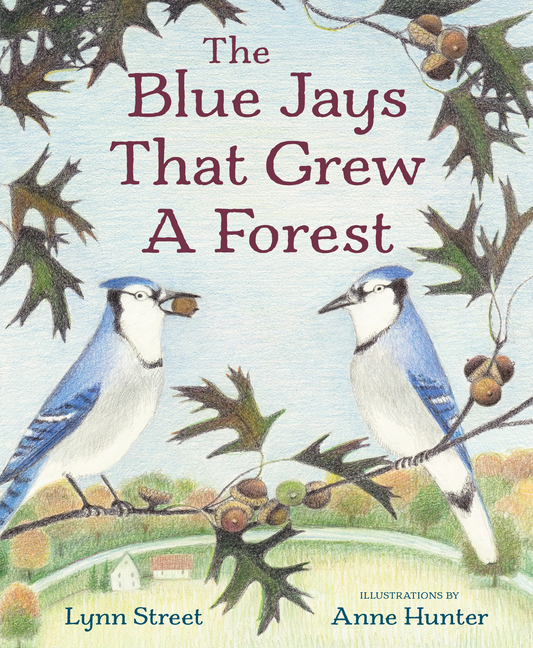
A polished, poetic narrative with rhythm and repetition delineates the symbiotic relationship between blue jays and oak trees in this appealing work of nonfiction. As winter approaches, blue jays—realistically illustrated in colored pencil with wide, staring eyes—begin the busy work of gathering and burying acorns that will become “future feasts and forests.” The jays’ hoarding of this edible treasure is just what oaks need, too: for their seeds to be carried to a space where, come spring, they might sprout and mature into trees. Carrying as many as five acorns at a time, the “blue crew” makes hundreds of trips over the countryside to gather acorns that “fall like hailstones / pummeling the dirt,” hiding them “near a clue to mark the location.” During the cold months, the birds will “dine on their hidden gems”—but there are some that will be forgotten underground. Over time, a forest expands, and new forests begin. “The jays and the oaks. / The oaks and the jays. / Thrive. / Together.” Additional information about oak trees and blue jays, including examples of other jays and oaks with similar mutualistic relationships; a glossary; further reading; and a bibliography are appended.
CCBC Choices 2026. © Cooperative Children's Book Center, Univ. of Wisconsin – Madison, 2026. Used with permission.
From the Publisher
Take a lyrical journey on the wings of blue jays as they bury thousands of acorns for next season's food and help Mother Nature extend the oak forests.
Most of us know about the mighty oak tree, and how important oaks are as a keystone species. But we may be less aware of the role that blue jays play in assisting the expansion of oak tree forests.
Covering one full year from season to season, we learn about the habits of the blue jays. All summer long they feed on bugs, berries, and seeds. But as autumn approaches, they perch in the canopy waiting for the acorns to ripen. With cold weather coming soon, this blue crew hauls away acorns, each bird taking as many as five per load. They fly over a farm or two and hide the acorns in a sunny open area where they can find them later when other food is scarce. But not all acorns will be eaten. Little do the jays know that the treasures they bury may one day become the beginnings of a new oak forest.
This debut picture book from poet Lynn Street lyrically celebrates the connection between blue jays and oak trees. It will appeal to readers fascinated by the behavior of birds and by the reciprocal relationships found in nature. While jays depend on acorns for food, the oak depends on jays to scatter its fruit far and wide. Blue jays have specially developed pouches in their throats that allow them to carry several acorns at a time, and they can travel as far as 1,500 miles in a season burying their acorns. A keystone species in oak forest ecosystems, these familiar birds are thought to have contributed to reestablishing oak forests after the last ice age. The detailed back matter provides further information about oaks and jays.
Geisel Honoree artist Anne Hunter, who lives in the jay-filled woods of Vermont, illustrated this book with great affection for these beautiful, clever, and sometimes noisy birds. After reading this book, you will see blue jays in an entirely new light.
Eureka! Nonfiction Children's Book Silver Award
Most of us know about the mighty oak tree, and how important oaks are as a keystone species. But we may be less aware of the role that blue jays play in assisting the expansion of oak tree forests.
Covering one full year from season to season, we learn about the habits of the blue jays. All summer long they feed on bugs, berries, and seeds. But as autumn approaches, they perch in the canopy waiting for the acorns to ripen. With cold weather coming soon, this blue crew hauls away acorns, each bird taking as many as five per load. They fly over a farm or two and hide the acorns in a sunny open area where they can find them later when other food is scarce. But not all acorns will be eaten. Little do the jays know that the treasures they bury may one day become the beginnings of a new oak forest.
This debut picture book from poet Lynn Street lyrically celebrates the connection between blue jays and oak trees. It will appeal to readers fascinated by the behavior of birds and by the reciprocal relationships found in nature. While jays depend on acorns for food, the oak depends on jays to scatter its fruit far and wide. Blue jays have specially developed pouches in their throats that allow them to carry several acorns at a time, and they can travel as far as 1,500 miles in a season burying their acorns. A keystone species in oak forest ecosystems, these familiar birds are thought to have contributed to reestablishing oak forests after the last ice age. The detailed back matter provides further information about oaks and jays.
Geisel Honoree artist Anne Hunter, who lives in the jay-filled woods of Vermont, illustrated this book with great affection for these beautiful, clever, and sometimes noisy birds. After reading this book, you will see blue jays in an entirely new light.
Eureka! Nonfiction Children's Book Silver Award
Publisher description retrieved from Google Books.

